Blog
Tutorials
How to Build a Custom GPT for Sales Training
A step-by-step guide to building your own GPT for sales roleplay — plus the hard-earned lessons on where DIY AI coaching hits its limits.

Moritz Beck
CTO
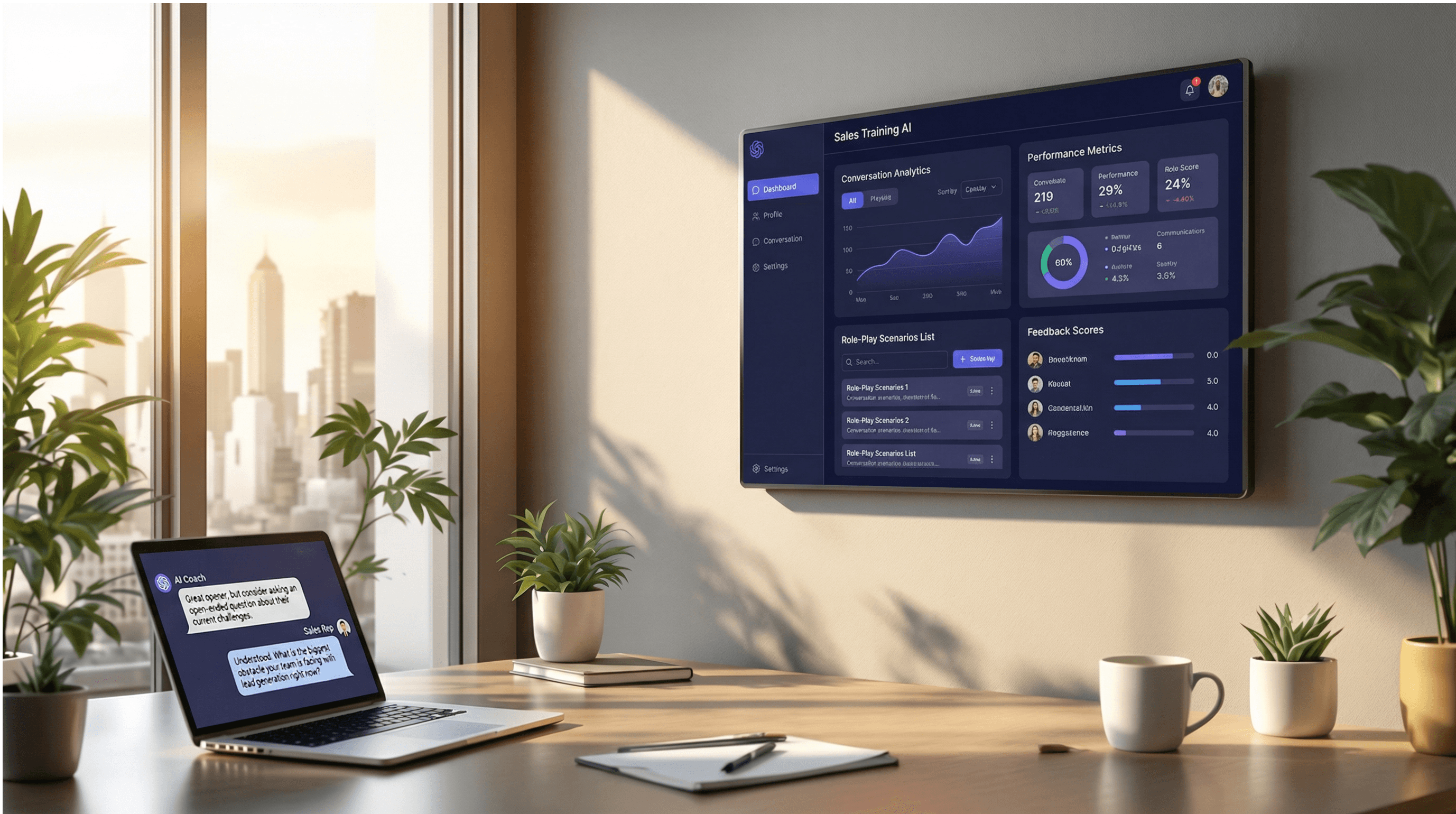
Yes, You Can Build Your Own GPT to Train Your Sales Team. Here’s How
Sales leaders are resourceful. So when ChatGPT made it possible to create custom bots that simulate buyer conversations, plenty of teams jumped on it. And honestly? It works — to a point.
This guide walks you through exactly how to build a DIY GPT for sales training, what you’ll gain from it, and where the cracks start to show. By the end, you’ll understand when it makes sense to graduate to a purpose-built platform.
How to Build a Custom GPT for Sales Practice
Setting up a basic training bot is surprisingly straightforward. Here’s the playbook:
Step 1 — Pick your platform
Use OpenAI’s custom GPT builder (available with ChatGPT Plus) or set up a system prompt via the API. If you want something quick and free, a well-crafted system prompt in any major LLM will get you started.
Step 2 — Write the buyer persona
This is the core of your bot. A good persona prompt includes:
Identity: name, title, company, years of experience
Company context: what the company does, team size, growth stage, current challenges
Goals and opinions: what this buyer cares about, what they’ve tried before, what’s worked and what hasn’t
Objections: the real reasons they push back — budget, timing, skepticism, competing priorities
Behavioral style: are they chatty or terse? Skeptical or open? Do they go on tangents?
Step 3 — Define the call structure
Give the bot a framework for how the conversation should flow:
Greetings and rapport
Agenda setting
Discovery questions
Pitch or demo
Objection handling
Next steps and close
Step 4 — Add guardrails
Tell the bot what not to do. For example:
Don’t volunteer information the rep hasn’t asked for
Don’t break character
Only share one detail per answer (so the rep has to dig)
Never ask “How can I help you?”
Step 5 — Run a practice session
Have your rep open the chat and treat it like a real call. Cold call, discovery, demo — whatever you want to drill.
That’s it. You now have a basic AI buyer your team can practice with.
The Pros — Why This Is Worth Trying
Let’s give credit where it’s due. A custom GPT for sales training has real advantages:
It’s fast. You can go from zero to a working roleplay bot in under an hour.
It’s cheap. A ChatGPT Plus subscription costs $20/month. That’s less than a single lunch-and-learn.
Reps can practice anytime. No need to coordinate schedules with a manager or peer. Midnight before a big call? Go for it.
It’s better than nothing. And for most teams, “nothing” is exactly what reps get between quarterly trainings and the occasional ride-along.
For a founder or small team running lean, this can genuinely move the needle — especially for onboarding or prepping for a specific deal.
The Limitations — Where the DIY Approach Breaks Down
Here’s the thing about custom GPTs: they’re great for the first conversation and terrible for the fiftieth.
No memory, no progression
Your GPT doesn’t remember what happened last session. It can’t track that a rep keeps fumbling the budget conversation or always skips qualification. Every session starts from zero. That means there’s no learning curve — just a flat line.
No scoring, no visibility
After a practice session, what does the manager see? Nothing. There’s no dashboard, no score, no way to compare reps or track improvement over time. The rep might practice ten times or zero times — you’d never know.
Generic feedback
Ask a GPT for coaching and you’ll get something like: “Try asking more open-ended questions to uncover the prospect’s pain points.” That’s not wrong. It’s just not useful. It’s the sales training equivalent of telling someone to “just be more confident.” Real coaching requires precise, contextual feedback — the exact words to say in a specific moment, grounded in what actually works in your industry and deal cycle.
Reps learn to game it
This happens faster than you’d think. After a few sessions, reps figure out the bot’s patterns and start optimizing for the simulation rather than the skill. Without variation, difficulty scaling, and anti-gaming detection, practice becomes performance theater.
No connection to real calls
Your GPT has no idea what’s actually happening on your team’s live calls. It can’t surface that three reps are consistently losing deals at the negotiation stage, or that new hires are skipping discovery entirely. The training exists in a vacuum, disconnected from the data that should be driving it.
It doesn’t scale
Building one persona is fun. Building forty — across different industries, seniority levels, buying stages, and objection profiles — is a full-time job. Now multiply that by methodology alignment (MEDDIC, SPICED, Sandler), language variants, and evolving product messaging. What started as a clever hack becomes an unmaintainable mess.
The success rate problem
MIT research found that 95% of generic AI pilots fail to deliver lasting results. For purpose-built vertical solutions, that number drops to 30%. The difference isn’t the AI — it’s the infrastructure around it: workflows, feedback loops, integrations, and domain-specific training data.
What a Dedicated Platform Actually Solves
This isn’t about replacing your GPT experiment. It’s about understanding what a purpose-built sales training platform adds on top of it:
Adaptive practice that adjusts to each rep’s actual skill gaps — not a one-size-fits-all script
Precise feedback trained on real sales training data, giving reps specific sentences to use, not vague advice
Manager dashboards that show who’s practicing, where they’re improving, and where they’re stuck
Integration with call recording tools like Gong, so training is driven by what’s happening on real calls
Setup in minutes — new personas, scorecards, and training paths without writing a single prompt
Anti-gaming mechanics that keep practice challenging and honest as reps improve
Methodology alignment built in, so every practice session reinforces your team’s actual sales process
The gap between a custom GPT and a dedicated platform is the same gap between a spreadsheet and a CRM. Both store data. Only one runs your business.
The Bottom Line
Build the GPT. Seriously — do it this week. Let your reps practice a cold call or two. Watch their energy shift when they realize they can rehearse a tough conversation without the pressure of a live prospect.
Then notice what’s missing.
Notice that you can’t tell who practiced. Notice that feedback stays generic. Notice that the bot doesn’t get harder as reps get better. Notice that your best rep and your newest rep get the exact same experience.
That’s the moment you’re ready for a real platform — one that turns practice into performance, and performance into pipeline.
Want to see what structured AI sales training actually looks like? Book a demo with Zell and find out how teams are cutting ramp time by 60% while keeping training completion above 90%.
Moritz Beck
CTO
Share


Now live
Partner program launched
We’re opening a new way for agencies, creators, and operators to grow with us.
Explore the program